Everything you need to know about the Seine in Paris. History, most beautiful bridges, boat cruises, swimming, and tips for exploring the river on foot.
Every great city has a geographical fact that precedes everything else. For Paris, that fact is the Seine. Before the boulevards, before the monuments, before the arrondissements and the Métro and the café terraces, there was a river cutting through a limestone plain — and on an island in the middle of that river, the first permanent settlement that would become one of the most consequential cities in human history.
The Seine did not merely provide a convenient location for Paris. It shaped the city’s economy, its defenses, its culture, and its spatial logic in ways that remain visible today. The Right Bank and the Left Bank are not administrative fictions — they are real distinctions in character, history, and social identity that trace directly back to the river’s influence on urban development over two millennia.
To understand Paris is, in part, to understand the Seine.
The Seine Through History
Roman Origins
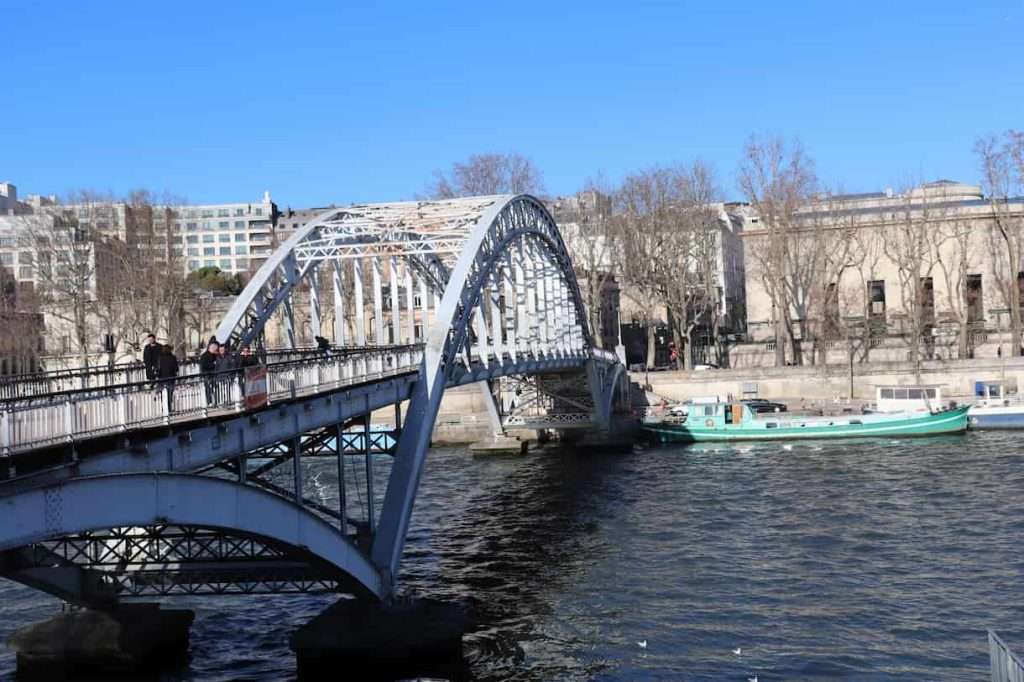
The Celtic Parisii tribe settled on the Île de la Cité — the largest island in the Seine at this point — sometime around the 3rd century BC. The river offered natural defenses on all sides and easy access to the trade networks that ran along the waterway. When the Romans arrived in 52 BC and established Lutetia, they built their administrative center on the island and expanded onto the Left Bank, where the terrain was more suitable for the grid planning characteristic of Roman urbanism.
Medieval Trade and Power
Through the medieval period, the Seine was the commercial artery of Paris. Everything that sustained a growing city — grain, wine, timber, stone — arrived by river. The powerful guild of river merchants, the marchands de l’eau, held significant political authority and their symbol — a ship on a field of waves — became the basis of the city’s coat of arms, still in use today.
The city’s motto, Fluctuat nec mergitur — tossed by waves but does not sink — is a direct reference to this riverine identity. It took on new resonance after the 2015 attacks, appearing on walls and banners across Paris as an expression of the city’s resilience.
Industrial Era and Decline
The 19th century brought industrialization to the riverbanks. Factories, tanneries, and laundries lined the quays. The river, once relatively clean by the standards of a major city, became increasingly polluted as urban and industrial waste flowed into it unchecked. Swimming in the Seine — a common practice in the 18th and early 19th centuries — became dangerous and was eventually prohibited in 1923.
The Long Cleanup and Paris 2024
For most of the 20th century, the Seine running through Paris was essentially a visual and symbolic amenity rather than a living waterway. Fish populations collapsed, water quality was poor, and the river existed primarily as a backdrop to the city rather than an active part of it.
The effort to reverse this began seriously in the 1990s and accelerated dramatically in preparation for the 2024 Paris Olympics, which used the Seine for open-water swimming and triathlon events. A multi-billion euro investment in wastewater infrastructure, combined with decades of gradual ecological restoration, brought the river to a condition not seen in over a century. Several species of fish have returned, water quality testing showed results sufficient for competitive swimming, and Paris’s long ambition of reopening the Seine to public bathing moved meaningfully closer to reality.
The Islands of the Seine
The Seine within Paris contains two inhabited islands, each with a distinct character.
Île de la Cité
The larger of the two islands is the historical heart of Paris — the original settlement, the seat of royal and ecclesiastical power for centuries, and still home to some of the most significant monuments in the city. Notre-Dame de Paris, currently undergoing restoration following the 2019 fire, occupies the eastern end of the island. The Sainte-Chapelle, with its extraordinary Gothic stained glass, stands within the courtyard of the Palais de Justice. The Conciergerie, once a royal palace and later a prison during the Revolution, faces the Right Bank from the northern quay.
The island is dense, historic, and largely given over to institutions and tourism rather than residential life. It is essential to visit and difficult to linger in comfortably.
Île Saint-Louis
The smaller island immediately to the east of the Île de la Cité is one of the most extraordinary residential environments in Europe. Île Saint-Louis was developed in the 17th century as a planned residential district for the Parisian bourgeoisie, and it has retained that character with remarkable consistency ever since. The streets are quiet, the architecture is uniformly classical, and the atmosphere is closer to a provincial town than a capital city.
The island’s single main street, Rue Saint-Louis en l’Île, is lined with small shops, restaurants, and the legendary Berthillon ice cream establishment, which has been producing some of the finest sorbets and ice creams in Paris since 1954.
The Bridges of the Seine
Paris has 37 bridges crossing the Seine within the city limits. They vary enormously in age, style, and character.
Pont Neuf
Despite its name — Pont Neuf means New Bridge — this is in fact the oldest standing bridge in Paris, completed in 1607 under Henri IV. It was also the first Parisian bridge built without houses on it, a significant departure from medieval practice. The equestrian statue of Henri IV at its center and the characteristic semicircular alcoves along its length make it one of the most recognizable structures along the river.
Pont Alexandre III
The most extravagant bridge in Paris, built for the 1900 Universal Exposition and dedicated to the Franco-Russian alliance. Its single steel arch span — deliberately kept low to preserve sightlines to the Invalides and the Grand Palais — is decorated with gilded bronze figures, lamp standards, and allegorical sculptures of extraordinary elaboration. It is, by almost any measure, excessive. It is also magnificent.
Pont des Arts
The pedestrian bridge connecting the Institut de France to the Louvre was, for many years, famous for the practice of attaching padlocks to its railings as a symbol of romantic commitment. The sheer weight of accumulated locks — estimated at 45 tons at its peak — threatened the structure’s integrity and they were removed in 2015. The bridge has since been fitted with plexiglass panels. It remains a pleasant crossing with good views in both directions.
Pont de Bir-Hakeim
The two-level metal bridge in the 15th and 16th arrondissements, with its elevated metro line running along the upper deck, is one of the most cinematically recognizable structures in Paris. Scenes from Last Tango in Paris and Inception were filmed here. The ironwork, the rhythm of the columns, and the view upstream toward the Eiffel Tower make it a favorite location for photographers.
Boat Cruises on the Seine
Seeing Paris from the water offers a perspective that no street-level experience can replicate. The major landmarks — Notre-Dame, the Louvre, the Musée d’Orsay, the Eiffel Tower, the Invalides — appear in sequence from the river in a way that clarifies the spatial relationship between them.
Several operators run regular cruises along the Seine.
Bateaux-Mouches is the largest and best-known operator, running from the Pont de l’Alma on the Right Bank. The boats are large, the commentaries multilingual, and the experience efficient. Evening illuminated cruises are particularly popular.
Bateaux Parisiens operates from the Trocadéro and offers similar itineraries with slightly smaller vessels.
Vedettes du Pont Neuf runs smaller, more intimate boats from the Pont Neuf itself — a better option for those who find the larger cruise boats too impersonal.
For a less touristic experience, the Batobus operates as a hop-on hop-off river bus service with stops at eight key points along the river, from the Eiffel Tower to the Jardin des Plantes. It is a practical and pleasant way to move between different parts of the city while staying on the water.
https://youtube.com/shorts/kfwBZxmym4s
Walking the Seine
The quays of the Seine offer some of the finest urban walking in Europe. The full length of the river through Paris — approximately 13 kilometers from the Bois de Boulogne to the Bois de Vincennes — can be walked on both banks, though most visitors focus on the central stretch between the Eiffel Tower and the Île Saint-Louis
The Voie Georges Pompidou
The Right Bank expressway, long a barrier between the city and the river, was closed to traffic in 2016 and converted into a public promenade. The resulting space — wide, paved, and directly at water level — has become one of the most popular leisure routes in Paris, used by cyclists, runners, rollerbladers, and those who simply want to sit near the water.
The Left Bank Quays
The Left Bank quays between the Musée d’Orsay and the Institut du Monde Arabe offer a more varied walk, with the Promenade des Berges — a landscaped waterfront park with floating gardens, sports facilities, and café barges — occupying a stretch near the Assemblée Nationale.
The Bouquinistes
Along the Right Bank quays near the Île de la Cité, the bouquinistes — the green-painted booksellers’ stalls that have lined the Seine since the 16th century — are one of the most characterful features of the Parisian waterfront. They sell secondhand books, vintage prints, postcards, and maps. The stalls stretch for approximately three kilometers on both banks and are recognized by UNESCO as part of the intangible cultural heritage of Paris.
Practical Information
The Seine runs east to west through central Paris. The Right Bank (Rive Droite) is to the north; the Left Bank (Rive Gauche) is to the south.
Access to the quays is free at all times. The principal riverside promenades — the Voie Georges Pompidou on the Right Bank and the Promenade des Berges on the Left — are open to pedestrians and cyclists daily.
Boat cruises operate year-round, with increased frequency in spring and summer. Booking in advance is advisable for evening departures.
The Batobus operates seasonally, typically from April to early November.
Frequently Asked Questions
Can you swim in the Seine in Paris?
Swimming in the Seine was prohibited in 1923 due to pollution. Following major investments in water quality ahead of the 2024 Paris Olympics — where open-water events were held in the river — the city announced plans to open designated swimming areas to the public. The long-term ambition is for the Seine to be safely swimmable within Paris for the first time in a century.
Bateau‑Restaurant Paris (Dinner Cruises & Floating Restaurants)
Bateaux‑Mouches – Dinner Cruise
Port de la Conférence, 75008 Croisière‑dîner classique sur la Seine, vue sur tous les monuments. Menus français, ambiance touristique mais très demandée.
Bateaux Parisiens – Dinner Cruise
Port de la Bourdonnais, 75007 (Eiffel Tower) Dîner gastronomique avec orchestre live. Parcours premium, idéal pour photos de nuit.
Ducasse sur Seine
Port Debilly, 75016 Le bateau‑restaurant le plus haut de gamme. Cuisine signée Alain Ducasse, bateau électrique, expérience luxe.
Le Calife
3 Quai Malaquais, 75006 Bateau en bois, ambiance romantique, cuisine française maison. Très apprécié pour les couples.
Capitaine Fracasse
Île aux Cygnes, 75015 Dîner croisière convivial, bon rapport qualité‑prix. Départ au pied de la Statue de la Liberté.
Paris en Scène
Port de Solférino, 75007 Formule dîner plus abordable, croisière 1h15. Idéal pour un public jeune ou budget moyen.
Les Maquereaux (Floating Restaurant)
Quai de l’Hôtel de Ville, 75004 Pas une croisière : bar‑restaurant flottant. Ambiance cool, tapas, cocktails, vue sur l’Île Saint‑Louis.
faq
How long is the Seine?
The Seine is approximately 775 kilometers long in total, rising in Burgundy and flowing northwest to its estuary at Le Havre on the Normandy coast. Within Paris, it runs for approximately 13 kilometers.
What does Fluctuat nec mergitur mean?
It is the Latin motto of the City of Paris, meaning roughly « tossed by waves but does not sink. » It refers to the river merchant origins of the city and has become a broader symbol of Parisian resilience.
What is the oldest bridge in Paris?
The Pont Neuf, completed in 1607, is the oldest surviving bridge in Paris despite its name meaning « New Bridge. »
What are the bouquinistes?
The bouquinistes are the secondhand booksellers who line the quays of the Seine near the Île de la Cité. They have been a fixture of the Parisian waterfront since the 16th century and are recognized by UNESCO as part of the city’s intangible cultural heritage.
Is a Seine boat cruise worth it?
A boat cruise offers a genuinely different perspective on central Paris, placing the major landmarks in their correct spatial relationship to one another in a way that street-level exploration cannot. An evening illuminated cruise in particular offers views of the city that are difficult to replicate any other way. For a first visit to Paris, it is worth the time.
The Seine does not run through Paris the way a river runs through most cities — as a geographical boundary, a logistical asset, a thing to be bridged and managed. It runs through Paris the way blood runs through a body: constitutively, invisibly, as the condition that makes everything else possible. The city that exists without it is not a lesser Paris. It is not Paris at all.