Discover the Pont Alexandre III, Paris’s most ornate bridge. Golden sculptures, Belle Époque architecture, and stunning views over the Seine. History and visitor tips.
No bridge in Paris stops people in their tracks quite like the Pont Alexandre III. Crossing the Seine between the Esplanade des Invalides and the Champs-Élysées, it is a symphony of gilded bronze, ornate lamp posts, stone cherubs, and winged horses that somehow manages to be spectacular without being absurd. Built for the 1900 World’s Fair, it remains one of the finest examples of Belle Époque architecture anywhere in the world.
History of the Pont Alexandre III
A Franco-Russian Alliance in Stone and Bronze
The Pont Alexandre III was built to celebrate the Franco-Russian Alliance of 1892, one of the defining diplomatic events of the late 19th century. The bridge was named after Tsar Alexander III, who had signed the alliance, and his son Tsar Nicholas II laid the foundation stone during a state visit to Paris in October 1896.
The symbolic dimension of the bridge was carefully calculated. France and Russia were signalling to the rest of Europe — and particularly to Germany — that their friendship was solid, permanent, and worth commemorating in the most lavish architectural terms available.
Built for the 1900 World’s Fair
Construction began in 1896 and was completed in time for the Exposition Universelle of 1900, the World’s Fair that also produced the Grand Palais and the Petit Palais, both of which stand at the northern end of the bridge. The three monuments were conceived together as an ensemble, and they still function as one today — the bridge forming a grand ceremonial axis between the Seine and the avenue that leads to the Champs-Élysées.
The Engineers and Architects
The bridge was designed by the engineers Jean Résal and Amédée Alby, with decoration overseen by architects Gaston Cousin and Georges Morin-Goustiaux. The sculptural programme was executed by some of the leading artists of the day, including Emmanuel Frémiet and Georges Récipon, who created the famous gilded bronze groups at each corner.
Architecture and Decoration
A Single Span Across the Seine
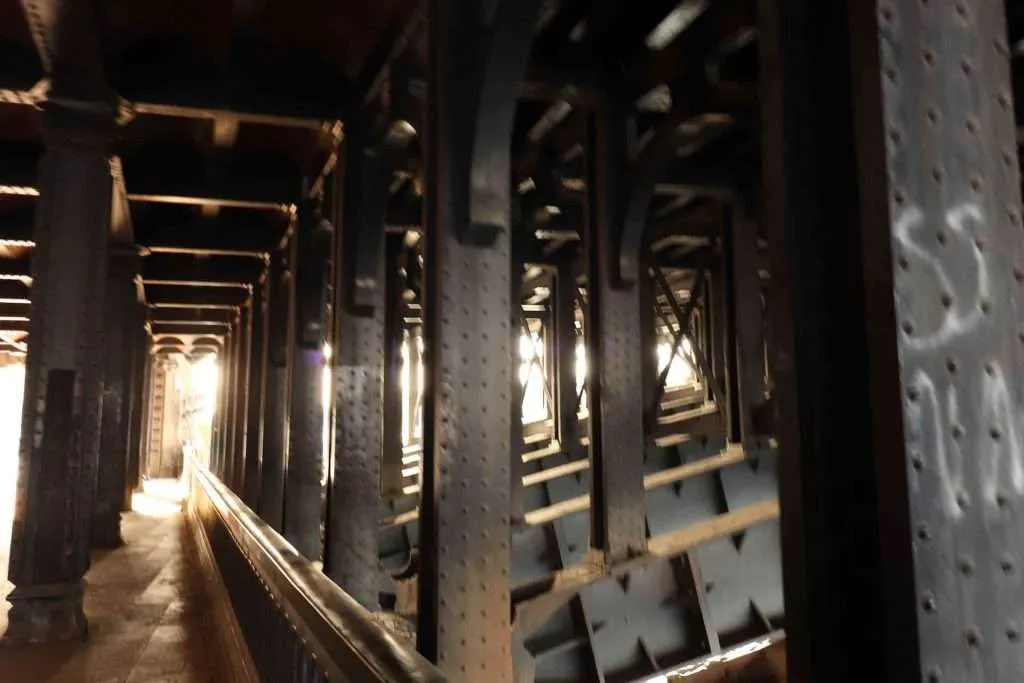
One of the most remarkable engineering achievements of the Pont Alexandre III is its structure. The bridge crosses the Seine in a single metal arch span of 107 metres, with a rise of only 6 metres. This extremely flat profile was a deliberate engineering choice — the bridge had to maintain an unobstructed view of the Invalides from the Champs-Élysées. Achieving this with 19th-century technology required considerable ingenuity.
The Four Pylons
At each corner of the bridge stands a tall stone pylon, each topped with a gilded bronze group. The four groups represent Fame — Fame of War, Fame of Commerce, Fame of Industry, and Fame of Art — and were designed to symbolise the achievements of both France and Russia. The gilding is not merely decorative: it was regilded most recently in 1999, and the warm gold catches the Paris light with particular brilliance in the late afternoon.
The Lamp Posts and Cherubs
The bridge carries 32 lamp posts, each an elaborate confection of bronze, glass, and ornament, flanked by cherubs, fish, and sea creatures. Walking across the bridge at dusk, when the lamps are lit against a darkening sky, is one of the more theatrical experiences Paris offers to anyone willing to linger.
The Nymphs of the Seine and the Neva
Beneath the arches, large bronze groups represent the Nymphs of the Seine on one side and the Nymphs of the Neva — the river running through Saint Petersburg — on the other. It is a detail that most visitors miss entirely, but it encapsulates the Franco-Russian symbolism embedded throughout the bridge’s decoration.
The View from the Pont Alexandre III
Standing at the centre of the bridge offers one of the great Parisian panoramas. To the south, the golden dome of the Invalides rises above the tree line. To the north, the Grand Palais and Petit Palais frame the avenue leading toward the Champs-Élysées. Along the river in both directions, the Seine stretches away past the bouquinistes stalls, the tree-lined quays, and the distant silhouettes of other bridges.
It is one of the few points in Paris where several of the city’s great monuments align in a single field of view, and photographers — amateur and professional alike — return to it repeatedly at different hours and in different light.
Pont Alexandre III and the Seine River Cruises
The Pont Alexandre III is one of the most photographed bridges on the Seine river cruise routes. Every Bateaux Mouches and Batobus service passes beneath its arch, and the view looking up at the gilded sculptures from the water is quite different from the view from the bridge itself. If you are planning a Seine cruise, the approach to the Pont Alexandre III is one of the highlights of the journey.
Practical Visitor Information
Location
The Pont Alexandre III connects the 7th and 8th arrondissements of Paris, linking the Esplanade des Invalides on the south bank to the Avenue du Général Eisenhower on the north bank, close to the Grand Palais and the Champs-Élysées.
Getting There
- Metro line 8 and 13: Invalides station (south bank)
- Metro line 1 and 13: Champs-Élysées Clemenceau (north bank)
- RER C: Invalides station
- The bridge is also easily walkable from the Place de la Concorde (15 minutes) or from the Eiffel Tower (25 minutes along the river)
Best Time to Visit
The bridge is open at all hours and free to cross on foot. The most rewarding times to visit are early morning, when the light is soft and the bridge is quiet, and at dusk, when the lamp posts are illuminated and the golden sculptures glow against the evening sky. The bridge is extremely popular with photographers at sunset.
Combining with Nearby Attractions
The Pont Alexandre III sits at the centre of one of Paris’s richest concentrations of monuments. Within easy walking distance are the Invalides and Napoleon’s tomb, the Grand Palais and Petit Palais, the Champs-Élysées, the Place de la Concorde, and the banks of the Seine. A half-day itinerary combining all of these is very natural.
Frequently Asked Questions
Why is the Pont Alexandre III named after a Russian tsar?
The bridge commemorates the Franco-Russian Alliance of 1892, a diplomatic partnership between France and Russia. It was named after Tsar Alexander III who signed the alliance, and his son Nicholas II laid the foundation stone in 1896.
When was the Pont Alexandre III built?
Construction began in 1896 and the bridge was completed and inaugurated in 1900 for the Paris World’s Fair, the Exposition Universelle.
Is the Pont Alexandre III free to visit?
Yes, the bridge is a public road and free to cross at any time on foot, by bicycle, or by car.
What are the golden statues on the Pont Alexandre III?
The four gilded bronze groups at the corners of the bridge represent the four Fames — Fame of War, Fame of Commerce, Fame of Industry, and Fame of Art. They were created by leading sculptors of the Belle Époque period and regilded most recently in 1999.
What is the best view from the Pont Alexandre III?
Standing at the centre of the bridge gives a panoramic view of the Invalides dome to the south and the Grand Palais to the north. The view from the water below — visible from Seine river cruises — is equally spectacular.
Is the Pont Alexandre III lit up at night?
Yes. The bridge’s elaborate lamp posts are illuminated every evening, and the gilded sculptures are also lit, making it one of the most beautiful night-time sights along the Seine.
Why was the Pont Alexandre III built?
The bridge was built to celebrate the Exposition Universelle (World’s Fair) of 1900 and to symbolize the Franco-Russian Alliance signed in 1892. It aimed to showcase French engineering, industrial prowess, and cultural elegance to the world.
Who is the Pont Alexandre III named after?
It is named after Tsar Alexander III of Russia. His son, Tsar Nicholas II, laid the foundation stone for the bridge’s construction in October 1896 as a tribute to his father and the diplomatic ties between the two nations.
What architectural style is the Pont Alexandre III?
The bridge is a masterpiece of the Beaux-Arts style, heavily influenced by Art Nouveau elements. It is famous for its symmetry, grandiose classical themes, and lavish decorations, including gilded statues, ornate copper nymphs, and winged horses.
What makes the bridge’s engineering unique?
Architects Jean Résal and Amédée Alby designed the bridge as a single-arch steel span of $107\text{ meters}$. To keep the view completely clear between the Champs-Élysées/Grand Palais and the Invalides, the bridge was built remarkably low, standing only $6\text{ meters}$ high.
What do the four large pillars represent?
The four $17\text{-meter-high}$ stone pylons act as counterweights for the bridge’s massive arch. Atop each pillar sits a gilded bronze statue of Pegasus and Fame, representing the four pillars of French society at the turn of the 20th century: the Arts, the Sciences, Commerce, and Industry.
Riviera Fuga
Adresse : 10 Port des Invalides, 75007 Paris
Le style : Une magnifique péniche-restaurant amarrée juste à côté du pont. Elle offre une vue panoramique incroyable sur le Pont Alexandre III et le Grand Palais. La cuisine est une fusion originale et moderne entre l’Italie et le Japon (comme leur célèbre pizza fritta au riz). Le décor inspiré de la French Riviera en fait un spot ultra-Instagrammable pour vos lecteurs.